
A higher battery voltage does not automatically mean more stored energy. Two configurations can provide the same nominal kWh at different voltage and Ah ratings, while requiring different inverter input ranges and expansion arrangements.
Battery selection is a system decision, not a contest between voltage labels. Comparing two published ELECNO configurations at the same nominal energy makes the distinction concrete: the energy can match even when voltage, dimensions and weight do not.
In this article, low-voltage and high-voltage refer to battery-market and product-family terminology. They are not legal electrical classifications or claims that any battery is safe to touch. Installation and servicing require qualified personnel following the applicable equipment instructions and local requirements.
Equal Energy, Different Voltage
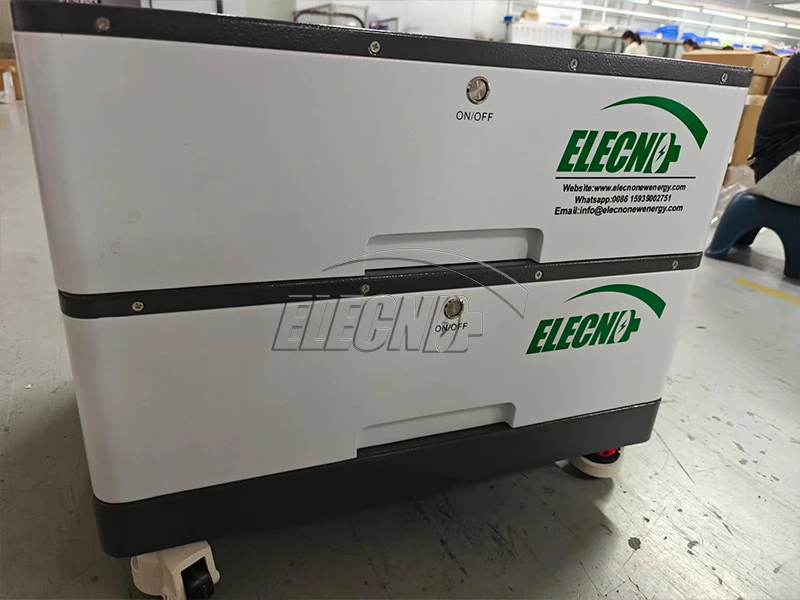
Two configurations in the ELECNO stacked battery catalog provide a useful comparison. The 51.2V series lists a 200Ah configuration, while a separate variable-voltage series lists a 102.4V, 100Ah configuration. Both are listed at 10.24kWh.
| Catalog item | 51.2V configuration | 102.4V configuration |
|---|---|---|
| Model | ELE51.2 200AH | ELE102.4 100AH |
| Rated voltage | 51.2V | 102.4V |
| Capacity | 200Ah | 100Ah |
| Listed energy | 10.24kWh | 10.24kWh |
| Listed dimensions | 542 × 500 × 350mm | 542 × 500 × 450mm |
| Listed weight | 86kg | 100kg |
These are selected catalog examples, not a statement that the two systems use identical accessories or offer identical usable energy. Confirm the issued configuration datasheet before ordering.
The nominal-energy arithmetic is 51.2 × 200 ÷ 1,000 = 10.24kWh and 102.4 × 100 ÷ 1,000 = 10.24kWh. Ah alone is therefore not a valid way to compare batteries at different voltages.
Voltage and Current
At an assumed 6,000W DC power level, dividing power by voltage gives approximately 117.2A at 51.2V and 58.6A at 102.4V. The higher-voltage example needs less current for that same idealized DC power.
This arithmetic does not establish either product’s allowed current, inverter efficiency or cable size. Actual voltage changes during operation, and manufacturer limits and the complete electrical design still apply. Do not turn a nominal-voltage calculation into installation instructions.
A claim such as “higher voltage always gives better efficiency” leaves out the inverter, battery configuration, operating conditions and installation. Ask for relevant equipment data or system evidence instead of selecting from that slogan.
Inverter Requirements
Check the battery’s full operating range against the inverter’s supported battery input—not just nominal voltage. Also establish the communication requirements and the minimum and maximum approved battery configuration for the intended operating mode.
Manufacturer support can differ within the same battery brand. As one documented example, Victron’s BYD integration page identifies supported low-voltage models and states that BYD HVS/HVM high-voltage batteries are not compatible with the equipment covered by that page. The lesson is model-specific verification, not a general recommendation for any ELECNO pairing.
Use the battery–inverter matching checklist to record the actual models, firmware and integration evidence.
Expansion Architecture
In the listed 51.2V family, selected larger configurations retain that rated voltage while their Ah and listed energy change. In the separate stacked family, selected configurations have different rated voltages. These catalog patterns are not permission to rewire modules or add units without approval.
Ask the supplier to define the initial configuration and the proposed future one. Record whether an addition changes the operating-voltage range, controller requirements, supported inverter arrangement or physical installation. A module that fits mechanically is not necessarily an approved electrical addition.
Site and Application Requirements
Begin with the intended loads, target backup hours and operating mode. An existing inverter can narrow the available battery options before the enclosure is chosen. For a new installation, compare complete equipment proposals at the required energy and output power rather than ranking isolated battery labels.
Include handling, installation space, controller accessories and commissioning in that comparison. A backup-energy calculation defines the capacity target; a documented integration plan defines whether the proposed equipment can deliver it.
Neither voltage architecture wins every comparison. The useful choice is the one supported by the proposed equipment and appropriate for the site—not simply the option with the higher number.
Related Stacked Battery Products
 Variable-voltage stacked familyCompare rated-voltage configurations →
 51.2V stacked familyCompare complete battery configurations →
Images illustrate product families and do not prove voltage or module count. Request a configuration comparison with your inverter model and target energy requirement.
Sources reviewed October 14, 2026: linked ELECNO product specifications and Victron Energy’s BYD integration documentation. Catalog values identify separate configurations; images do not establish a tested pairing. Current and energy calculations are explanatory examples, not performance tests or installation instructions.