

Wall-mounted and stackable batteries can offer similar nominal capacity, but they use space differently. Wall-mounted units spread across a supporting wall; stacked modules share a floor-supported base. The choice affects mounting, access and future expansion—not just appearance.
The useful comparison is therefore not simply which battery looks more compact. It is how the complete arrangement fits the property today—and whether it can still be maintained or expanded tomorrow. ELECNO’s project photographs and catalog examples help make those differences visible.
Wall-Mounted Battery Layout
The Nigeria villa project photograph shows several battery enclosures arranged horizontally on a wall. This leaves the floor below them available and keeps the units visible rather than building a tower in the room. It also shows why the wall layout has to be considered as a whole: the installer must accommodate the equipment, connection routes and access to individual units.
That arrangement can be attractive where floor space is limited. Its practical requirement is a suitable supporting structure and an approved mounting arrangement for the selected model. Adding another enclosure also requires another usable mounting position—not just spare battery capacity in an electrical calculation.
View the Nigeria villa solar project →
Stacked Battery Layout
The Malaysia shipment materials show two-level battery assemblies sitting on bases. Here, modules occupy a shared vertical arrangement instead of separate wall positions. The layout is easy to understand visually, but the complete assembly—not a single module—is what needs to fit the intended location.
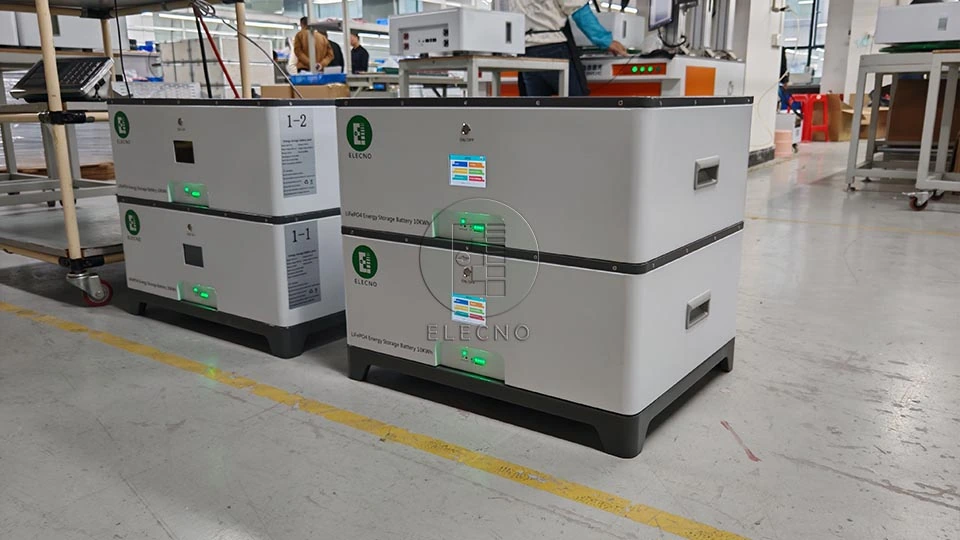
For this type of arrangement, the base, assembled height and access around the unit all matter. A taller configuration can change handling and service access even when its nominal voltage remains the same. The installation drawing should show the complete proposed assembly and its required clearances.
View the Malaysia stacked battery module shipment →
Dimensions and Weight
Selected ELECNO models illustrate the physical difference. The examples below are separate catalog configurations; they are not specifications inferred from the project photographs.
| Configuration | Rated voltage / capacity | Listed dimensions, L × W × H | Listed weight |
|---|---|---|---|
| Wall-mounted ELE51.2 100 | 51.2V / 100Ah | 610 × 350 × 150mm | 40kg |
| Stacked ELE51.2 100AH | 51.2V / 100Ah | 542 × 500 × 175mm | 43kg |
| Stacked ELE51.2 200AH | 51.2V / 200Ah | 542 × 500 × 350mm | 86kg |
The first two entries have the same listed voltage and Ah, yet different shapes and weights. Within the selected stacked series, the larger 200Ah configuration is taller and heavier than the 100Ah entry. This is why a capacity-only comparison misses part of the installation decision.
Sources: wall-mounted battery specifications and 51.2V stacked battery specifications. Catalog dimensions describe the equipment, not the full installation space.
Expansion and Voltage Architecture
The word “stackable” does not identify one voltage architecture. In the listed 51.2V stacked family, the selected configurations retain the same rated voltage as capacity increases. A separate stacked product family includes configurations at different rated voltages, including 102.4V.
A future addition therefore needs both a physical plan and a supported electrical configuration. The battery arrangement, controller and inverter must be considered together. Selected wall-mounted models also list parallel-connection options, so expansion is not exclusive to tower-style enclosures.
For a new installation, define the initial system and the intended expanded system at the same time. That gives the supplier and installer a clear basis for choosing the equipment and reserving the necessary space.
Installation and Service Access
Wall-mounted equipment can suit a site that needs to keep its floor clear and has suitable mounting positions. A stacked arrangement can suit a site with an appropriate floor-supported location and room for the approved complete assembly.
In both cases, leave the required access to controls, connections and service areas. The most compact-looking arrangement is not necessarily the most practical if another unit, furniture or a cable route blocks the work needed later.
The deciding information is straightforward: a site layout, the selected inverter model, the target battery configuration and any planned expansion. With those details, the discussion moves from enclosure appearance to a system that fits the property.
Related Battery Products
 Wall-mounted batteriesCompare the available configurations →
 Stacked batteriesReview the listed 51.2V configurations →
Send your site layout and battery requirements to ELECNO for a configuration-specific discussion.
Technical note: catalog examples were checked on October 14, 2026. Final selection, expansion and installation must follow the issued configuration documents and equipment manuals. The photographs show installation or shipment stages, rather than independently measured performance.